A craving for something sweet can feel weirdly specific and weirdly strong, and there’s a reason for that. It’s a blood sugar and insulin pattern, and it repeats itself every time you eat something high in sugar without much else alongside it. Once you can see the pattern, the craving stops feeling random. It also stops feeling like something you did wrong.
What happens when a craving hits
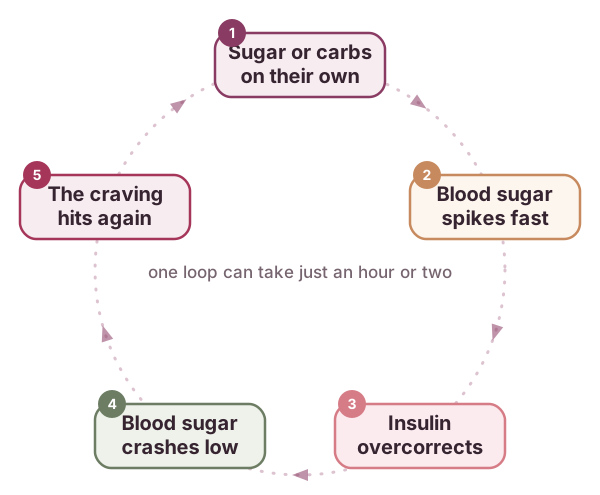
When you eat something high in sugar on its own, a cookie, a sugary coffee, a piece of toast with jam, your blood sugar rises quickly. Your body responds by releasing insulin to bring that blood sugar back down. When there’s a lot of sugar and not much else in the meal, insulin often overcorrects, and your blood sugar drops lower than where it started.
That drop is what you feel as a craving. It shows up as sudden hunger, a bit of shakiness, trouble focusing, or a pull toward something sweet again, usually within an hour or two of the first sugar hit. Your body isn’t being weak. Your blood sugar just fell, and sugar is the fastest way back up. It’s a physical loop, and it will keep repeating for as long as the meals that trigger it keep happening.
This is also why a piece of cake after a big, protein-and-fat-forward dinner rarely sends you spiraling, but the same piece of cake eaten on an empty stomach can set off cravings for the rest of the day. The food around the sugar changes how your body responds to it.
Why cutting everything out backfires
Most diets treat this problem by removing sugar entirely, often overnight, and often alongside cutting carbs, snacks, and anything that feels like a treat. It seems like the logical fix. If sugar causes the spike and crash, removing sugar should remove the cravings.
In practice, it tends to do the opposite. Restriction itself is stressful, and stress increases the same hormones that drive cravings in the first place. On top of that, going from a diet with plenty of quick sugar hits to one with none at all is a big enough shift that most people’s blood sugar swings even more in the first week or two, not less. That combination, a stressed body and unstable blood sugar, is exactly the environment cravings thrive in. This is a big part of why so many people can white-knuckle a strict diet for two or three weeks and then find themselves eating everything in the pantry at once. That’s not a discipline problem. Restriction layered on top of an already unstable system produces exactly that result.
Nights, stress, and the week before your period
Cravings aren’t evenly distributed through the day or the month, and there are real reasons for that.
By evening, most people have been managing decision fatigue and willpower all day, and blood sugar has usually had several ups and downs already from meals and stress. That combination makes the evening the easiest time for a craving to win.
Stress raises cortisol, and cortisol pushes blood sugar up on its own, which your body then has to bring back down with insulin, adding another swing on top of whatever your food has already caused. That’s why a stressful day so often ends with a strong pull toward something sweet, even if you ate reasonably well. Short sleep does the same job from the other end, by moving the hormones that tell you when you’re hungry and when you’ve had enough.
If the stressful day ended with a drink, that adds a swing of its own on a delay. Alcohol stops your liver releasing glucose overnight, which is why the cravings tend to land the next morning rather than the same night.
In the days before a period, hormonal shifts change how sensitive your body is to insulin, which can make blood sugar swings larger for the same food choices. That’s not a craving you’re imagining, it’s a real, temporary shift in how your body is handling sugar that week.
If you’re in perimenopause or menopause, this same volatility can become the norm rather than a once-a-month event. Why menopause makes sugar cravings and weight gain so much worse covers exactly what’s changing hormonally and what helps.
None of this means you’re broken or uniquely bad at this. It means the pattern has predictable triggers, and predictable things can be worked with. The free quiz walks through these same signs one at a time if you want to know which ones are yours.
The approach that breaks the cycle
The fix is changing what sugar shows up alongside, not adding more restriction.
Protein, fat, and fiber all slow down how quickly food is digested, which slows down how quickly sugar reaches your bloodstream. A smaller, slower rise means a smaller, gentler insulin response, which means no hard crash a couple hours later. Build a meal around a real source of protein and fat, add a vegetable for fiber, and the same sugar that would spike you eaten alone barely registers as part of a fuller plate.
This is also why weaning sugar down tends to work better than quitting it cold. Each time you replace a sugar-heavy snack with a plate built around protein, fat, and fiber, you’re giving your blood sugar one fewer big swing to recover from. Do that consistently and the baseline settles down on its own. The cravings that were being driven by constant swings start to quiet down, not because you’re resisting them through willpower, but because the swings that were causing them are smaller and less frequent.
One thing worth knowing here: a lot of the sugar driving these swings never comes from obvious treats. It hides in foods marketed as healthy, flavored yogurt, granola, protein bars. Hidden sugar in healthy foods covers exactly where it hides and what to check for.
One question to ask before you reach for something sweet
Did the meal before this have real protein and fat in it?
That’s it. That’s the habit. If the answer is no, you’ve found the gap, and it isn’t discipline. To go deeper on either piece, how much protein stops cravings and why fiber is the piece most people skip both have the real numbers. If you’ve quit sugar outright before and it came apart on you, cold turkey has a failure rate worth knowing about. For the week-to-week version, there’s what a low-sugar life actually looks like. And if this has been going on for years, what’s happening underneath it is worth an hour of your time, mostly because of how reversible it turns out to be.
The Plate Builder will put a plate together from what you’ve got on hand, plus a swap for whatever you’re craving this minute.
A note on when this is more than a craving cycle
For most people, what’s described here, cravings driven by blood sugar swings and made worse by stress or restriction, is the whole picture, and it responds well to the food-first approach above. For a smaller number of people, the pull toward sugar and highly processed food runs deeper than a blood sugar loop. If cravings feel like they’ve taken over in a way that food alone doesn’t explain, it’s worth talking to your doctor. That’s a different, more clinical conversation, and one worth having with the right support rather than trying to push through it alone.